Physical Address
304 North Cardinal St.
Dorchester Center, MA 02124
Physical Address
304 North Cardinal St.
Dorchester Center, MA 02124

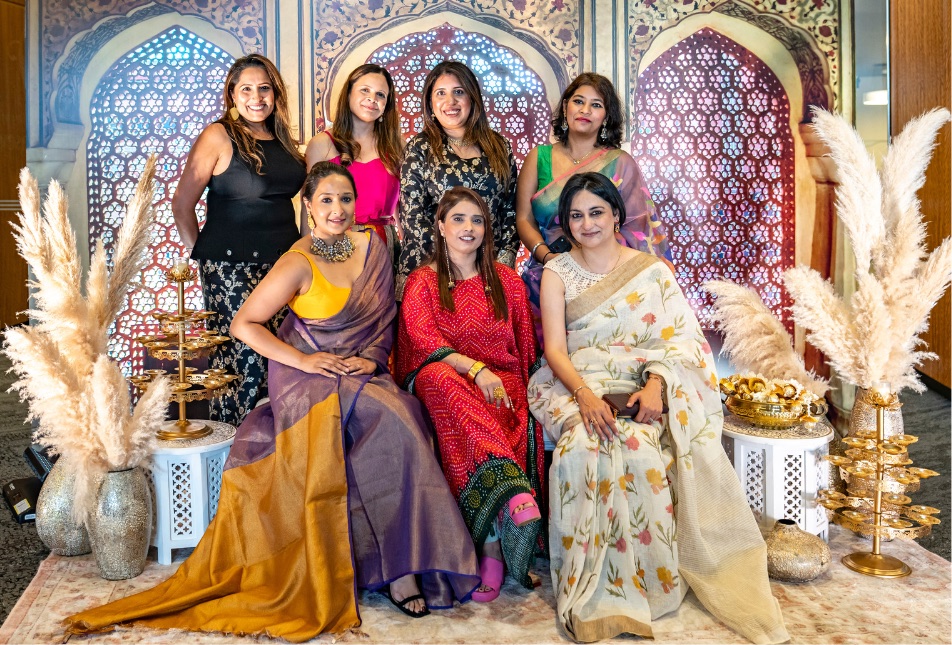
The Offbeat Sari, currently showing at Bunjil Place in the Melborne suburb Narre Warren and free to enter, is built around that idea of the sari’s multi-faceted personality.
In 2010, Lady Gaga wore a foiled jersey sari by Indian designer Tarun Tahiliani. In 2022, Bollywood actor Deepika Padukone arrived at the Cannes Film Festival in a ruffled, dramatically layered creation by Abu Jani Sandeep Khosla.
Both moments were treated as celebrity fashion events. What they were also doing was flagging something that has been quietly gathering momentum for years: the sari is in the middle of its most significant reinvention.
The Offbeat Sari, currently showing at Bunjil Place in the Melbourne suburb Narre Warren and free to enter, is built around that idea of the sari’s multi-faceted personality.
Developed by London's Design Museum and curated by Priya Khanchandani, it brings together 54 saris from some of India's best-known designers alongside emerging studios.
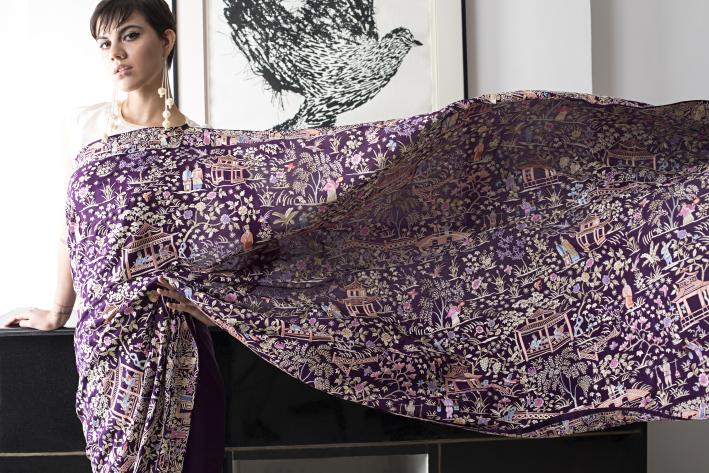
The history of the sari is long. The sari is estimated to be around 5,000 years old, making it one of the oldest continuously worn garments on earth. Traditionally a single length of unstitched fabric, anywhere from five to nine metres, it has reflected identity, region, class and occasion across South Asia for millennia.
The way it is draped varies dramatically by state, community and context. A Nivi drape from Andhra Pradesh looks nothing like a Gujarati or Bengali style. It has dressed farmers and film stars, brides and bureaucrats.
The saris at the exhibition are not pieces of heritage, but a living tradition that constantly evolves.
The Tahiliani and Abu Jani Sandeep Khosla pieces on display bring versions of the same design lineages that dressed Gaga and Padukone. So are works by Sabyasachi, whose bridal saris have become a cultural shorthand for a certain kind of aspirational South Asian femininity, and Anamika Khanna, whose deconstructed approach has long pushed at what the garment can structurally be.
Alongside them are labels like Raw Mango, Abraham and Thakore, Bodice and NorBlackNorWhite, each with a distinct take on where the sari goes next.
Some of the most striking work in the exhibition has nothing to do with couture. One section, Identity and Resistance, deals with the sari as a political object.
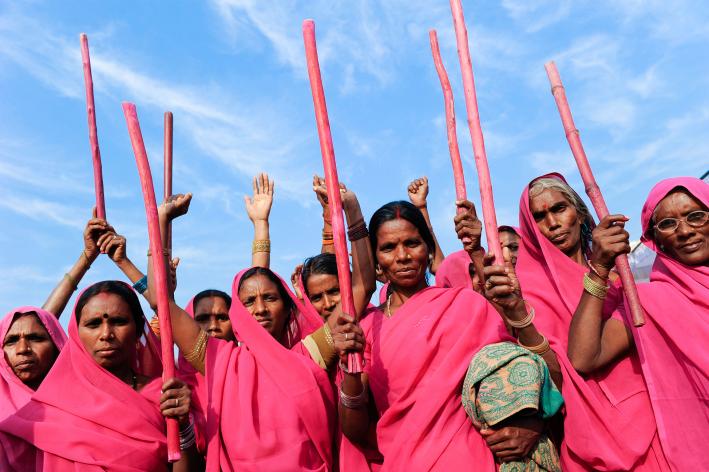
The standout is the hot-pink saris of the Gulabi Gang, a women's collective founded in Uttar Pradesh by Sampat Pal Devi that has campaigned against domestic violence, caste discrimination and corruption since the mid-2000s.
The pink sari is their uniform and their signal – visible, deliberate, impossible to ignore. Seeing it in an exhibition context, alongside protest imagery, is a reminder that clothing carries weight that fashion coverage rarely makes room for.
Elsewhere in the show, saris appear in the hands of activists and artists who have used the garment to challenge norms around gender and body image.
The third thread running through the exhibition is material innovation. There is a sari here constructed from ultra-fine stainless-steel wire shaped into gold waves. Another incorporates sequins punched from hospital X-ray film.
A denim sari. A pre-draped sari designed for women who want the look without the 20-minute ritual of putting it on.
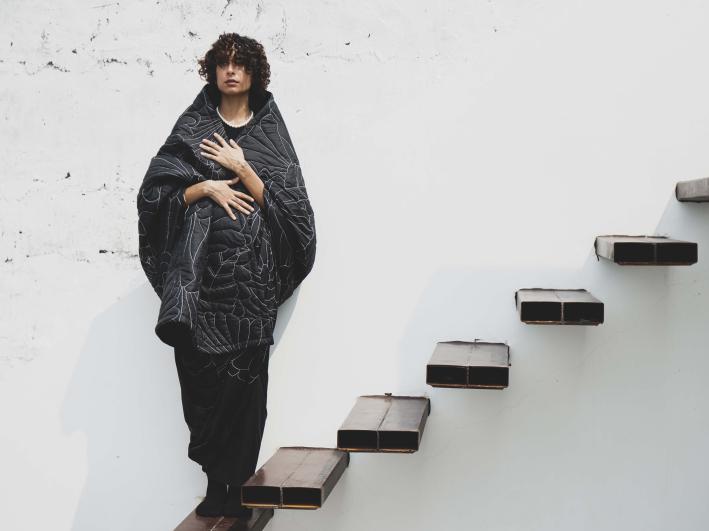
Curator Priya Khanchandani has described this moment as the sari's most rapid reinvention in its 5,000-year history. “The sari is experiencing what is conceivably its most rapid reinvention in its 5,000-year history,” Khanchandani said.
“This makes the sari movement one of today’s most important global fashion stories, yet little is known of its true nature beyond South Asia. What fascinates me most is that its reinvention isn’t simply aesthetic – it’s cultural, political and emotional. Designers and wearers are stretching the sari’s possibilities and transforming it into a catalyst for imagining new futures. I’m incredibly excited to be collaborating with Bunjil Place to bring this story to audiences in Australia.”
Bunjil Place, in Melbourne's south-east, was a deliberate landing spot for the Australian debut. The City of Casey has one of the largest South Asian communities in Melbourne.
“We’re incredibly proud to be collaborating with Liverpool Powerhouse to debut The Offbeat Sari,” City of Casey Mayor Stefan Koomen said.
“With one of the largest South Asian communities in Melbourne, this vibrant exhibition will deeply resonate with our residents and beyond. I encourage everyone to come and experience the bold reinvention of this iconic garment and with free entry to the Bunjil Place Gallery, it’s accessible for all to enjoy,” said Koomen.
After Melbourne, where it runs until 30 August, the show travels to Liverpool Powerhouse in Western Sydney, opening 7 November 2026 and running through to 4 April 2027.
Liverpool, too, has a substantial South Asian community, and the venue has positioned this as a Western Sydney event in its own right, not just a follow-on season.
“We’re proud to host the Sydney leg of The Offbeat Sari – presented exclusively in Western Sydney at Liverpool Powerhouse. This exhibition celebrates the evolution of an iconic garment through bold design and contemporary expression, offering audiences a fresh perspective on culture, creativity, and identity,” said Liverpool City Council Mayor Ned Mannoun.
Between Lady Gaga's 2010 moment and the Gulabi Gang's decades of organised resistance, the sari contains more than most people have given it credit for. This exhibition makes that hard to argue with.
The Offbeat Sari is at Bunjil Place Gallery, Narre Warren, until 30 August 2026. Free entry. The exhibition opens at Liverpool Powerhouse, Sydney, on 7 November 2026.